











Frequently Asked Questions - HDPE duct

  1. What is SDR?
  2. What is the minimum Bend Radius?
  3. What is the Limiting Pull-in Tension?
  4. What is the Duct Compression Limit?
  5. What will be the Duct Lifetime?
  6. Is it Resistant to Chemicals?
  7. Is Heat or Frost a Problem?
  8. What Impact will it Survive?
  9. What Specifications are Present?


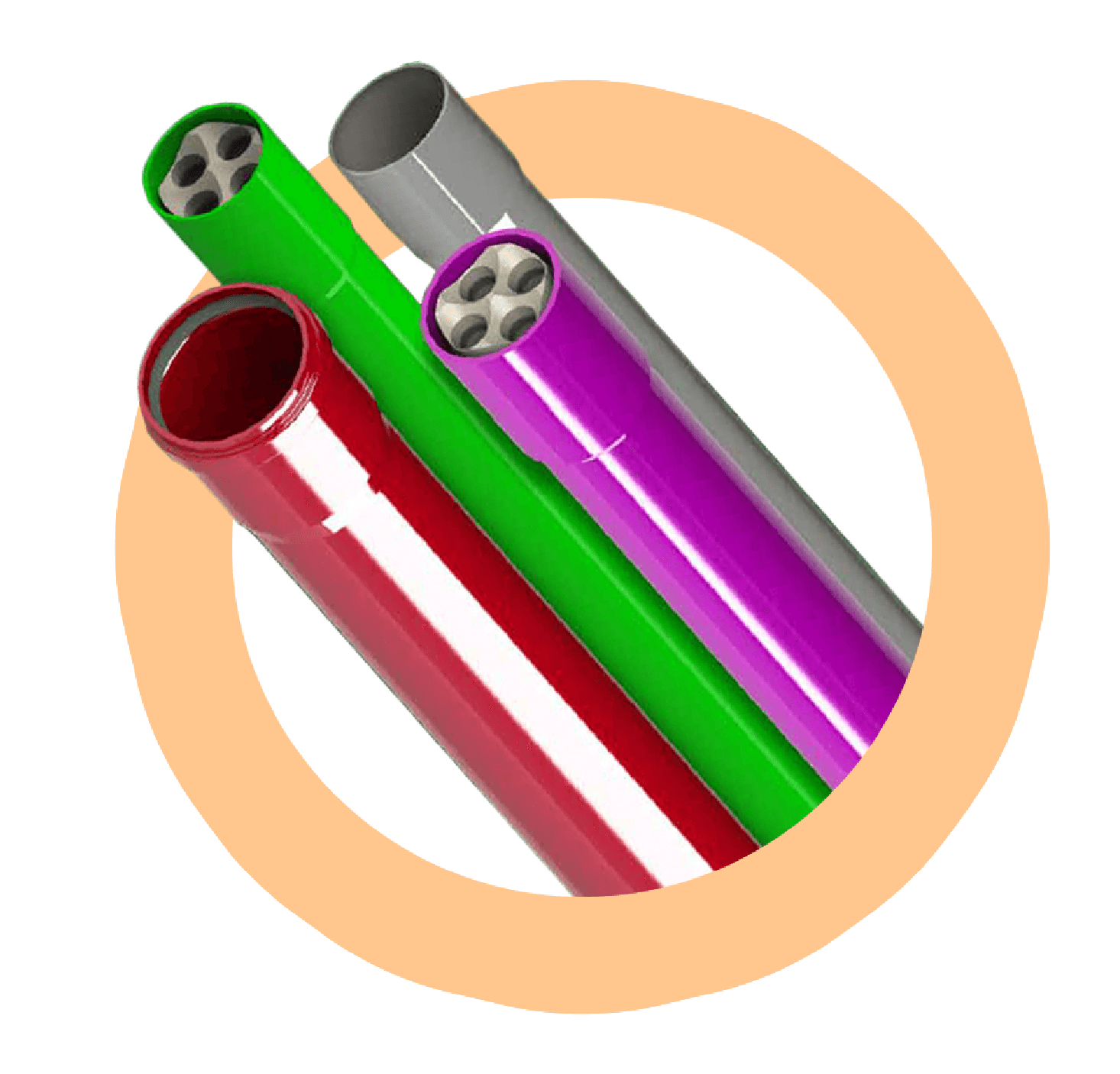
Various Duct Sizes and Colours.


Q1. What is SDR?

The Standard Dimension Ratio relates the outside diameter (OD) of the duct to its wall thickness (t),
so SDR = OD / t.
Note that low SDR means very strong duct. Higher SDRs mean thinner wall, more flexible, less strong. Note that different OD ducts that have the same SDR will tend to have similar flexibility and crush performance.


^ Top ^


Q2. What is the minimum Bend Radius?

All tube or duct will have a recommended bending radius limit, such that installing tighter than this can increase the risk of kinking (maybe not immediately, which should be remembered) or just less comfort for cables etc being installed later. Our generic spec MHT 582 gives recommended MBR data, as do our other specific datasheets.


^ Top ^


Q3. What is the Limiting Pull-in Tension?

Emtelle duct is made from high quality HDPE with excellent tensile behaviour. Ducts can normally be stretched to 14MPa or 15MPa stress levels and still recover closely to their original dimensions. We recommend lower stresses than this during installation, in order to reduce the amount of excess duct length required for full relaxation. Staying at say 2MPa permits fast installation, relaxation and cropping times by minimising elongation.
Example: 2MPa = 2 newtons per square mm of cross-section, eg for a 25/20 duct, the csa would be 177sqmm, and so 2MPa represents 2 x 177 = 354N load (35kg). You could safely use twice this tension, but would need to allow more relaxation length and time.


^ Top ^


Q4. What is the Duct Compression Limit?

When you accidentally stand on a duct, you do not want it to become useless for the job. And standing on a duct could mean a load of 80kg on a length of just 12 or 14cm. Ducts with SDR 10 or 11 are very typical and these can easily withstand such compression loads. The compression causes typically only 10% or 15% reduction in diameter, and when the load is removed, the duct begins a rapid recovery towards its original dimensions. Emtelle ducts are very resilient and forgiving.


^ Top ^


Q5. What will be the Duct Lifetime?

Polyethylene is one of the plastic industry's top performers in terms of length of service. PE is virtually inert and does not suffer from rotting, fungus or oxidation like wood or metal. And it is not prone to breakage due to impact, fatigue (repeat bending) or overload. That is one reason why cracked and broken IRON pipelines have been replaced all over the world by PE pipelines. They are expected to last for 25 or 50 years without serious deterioration. They out-perform the iron by being more suitable for the job.


^ Top ^


Q6. Is it Resistant to Chemicals?

PE has excellent chemical resistance properties and is able to resist most common contaminants in underground deployments. Please consult us if you have specific chemicals at your installation site.


^ Top ^


Q7. Is Heat or Frost a Problem?

Buried ducts generally see only low and very constant temperatures, around 10°C. The normal maximum installation temperature for our HDPE ducts is 40°C, since compression performance reduces at elevated temperatures. Low installation temperatures down to -40°C are permissible although the product may become notably stiffer and more difficult to manipulate. Note that at very low temperatures, we recommend using higher min bend radius. See the relevant data sheets.


^ Top ^


Q8. What Impact will it Survive?

As mentioned above, HDPE ducts can withstand impact energies and recover their shape, since they are not brittle. Flatter impact shapes will naturally cause less deformation, and faster recovery. The Emtelle datasheets define impact test levels and test details.


^ Top ^


Q9. What Specifications are Present?

EN 50086-1*               Conduit systems - General requirements
EN 50086-2-4            Buried conduit systems (metric)
ASTM F 2160            HDPE Conduit (inch dimensions)
BT LN461, 576, 650   Sub Duct Mono-bore (37, 32, 25mm)

*NB: EN 50086 is being phased out in favour of spec  EN 61386


^ Top ^


...withstanding the rigours of installation


Fibre Product CatalogueFibre Speedtest
EMTELLE NEWS ROOM
Emtelle Group are delighted to announce they have been awarded a major 3 to 5 year contract by BT Openreach

Read more...

CableCom Training has been granted approval as a certified Emtelle training provider